BLOG
The Best Custom IoT Hardware and Embedded Engineering Services for Startups

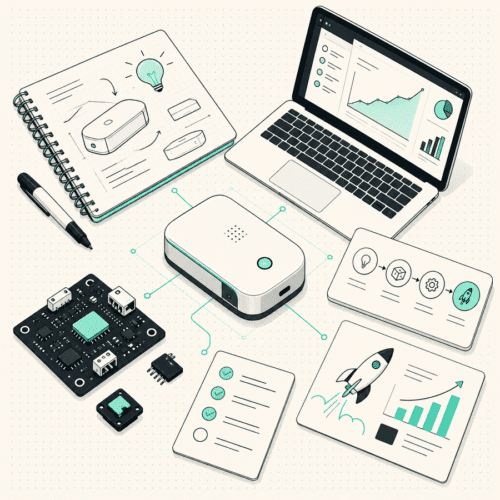
The best custom IoT hardware and embedded engineering services for startups are the ones that match the stage you are at, not the product you eventually want. Early on that means proving the idea works. Later it means a design a manufacturing partner can build at volume. A good provider tells you which stage you are actually in and scopes the work to it.
That sounds obvious, and it is where most early hardware budgets get spent badly. A startup pays for production tooling before the concept is proven, or builds a one off prototype that has to be thrown away before anyone can manufacture it. Below is what good services look like at each of the four stages, and what to ask for at each.
What the best services include at each stage
Stage 1. Proof of concept
What you are buying at this stage is an answer to one question: can this work at all? A good provider builds the single hardest part first, using components available today rather than designing new ones, so you find out whether the idea holds before you spend on everything around it.
Good services at this stage include an honest feasibility read before anything is built, a working demonstration of the hard part, and a clear view of what the product would cost to make later. Expect weeks, not months. Ask your partner which single assumption they are testing first, and what happens to the plan if it fails.
How we work with startups at this stage: tell us what the product needs to do and we’ll come back with the one assumption worth testing first, what it takes to prove it, and what that costs. A short scoped phase, not a full program. Start a conversation.
Stage 2. Working prototype
The goal is a device someone outside your team can hold and use. This is where custom electronics usually start, along with the enclosure, the software on the device, and the app or dashboard that goes with it.
Good services here include design work that already has manufacturing in mind, so the prototype becomes the basis of the real product rather than a dead end. You should also get an early view of certification requirements and a parts list with real suppliers behind it. Ask whether this design can be manufactured later, or whether it will need to be redone.
How we can help: our Industrial Design Sprint covers the physical product and the UX/UI Design Sprint covers the interface, each at a fixed price with the scope published up front. You come out with design files your engineers can build from and real code your developers can run, with the design system already embedded. Start a conversation.
Stage 3. Field testing
The goal is learning how the product behaves outside your office. A small batch goes to real users in real conditions, and the things no lab catches start showing up: battery life, connectivity, how people actually handle the device.
Good services at this stage include a way to update the software on units already in the field, data coming back that someone reviews, and a documented path for returns. Ask how many units they would put in the field first, and what they expect to learn from them.
How we can help: we build the batch, set the units up so the data comes back to you, and stay on through the first weeks in the field when the surprises arrive. Support services cover the monitoring and the updates after that. Start a conversation.
Stage 4. Production
The goal is a product that gets built repeatedly, at quality, by a manufacturing partner. Certification is completed, tooling is ordered, and the manufacturer gets everything it needs to build without your engineers in the room.
A good provider already has manufacturing partners and manages that relationship on your behalf. They review the design with the manufacturer before production starts, build the equipment that tests each unit as it comes off the line, and define how every unit gets set up and checked before it ships. Ask who owns that relationship in your engagement, because many startups reach this stage and find out the answer is nobody.
How we work with startups at this stage: Manufacturing Support, usually inside a Product Partnership that carries the product across phases through launch. We bring the manufacturing partners and run the design review with them, so your team is not managing that relationship alone. Start a conversation.
Where to start when the budget is limited
Start with the part of the product that would kill it if it does not work. For a wearable that is usually battery life and fit. For an industrial sensor it is whether the signal survives the environment. For a consumer device it is often the cost to build at volume. Pay to settle that question first, and the rest of the roadmap gets easier to fund.
Two things are worth buying early even on a small budget. The first is a parts list and cost estimate at your target volume, because it tells you whether the business works before the engineering does. The second is a design that can be manufactured later, so the money you spend on a prototype carries forward instead of being spent twice.
Fixed price engagements help here. A published scope and a published price let you buy one stage, see the work, and decide about the next one with real information.
How Very Technology delivers each stage
Very Technology has designed and built connected hardware, software, and AI systems since 2011, across more than 1000 engagements. A significant share of that work is with founders at pre seed through Series A.

Engagements run in committed phases, each with defined scope and a checkpoint at the end, so you approve the next one because the last one earned it. The engineers who scope the work are the engineers who build it. The client owns all intellectual property on delivery, every engagement.
For founders who want a fixed price and a published scope to start from, Very’s sprints cover bounded pieces of this work, including industrial design and the interface your customers will use.
What does Very offer a startup, and what does it cost?
You need to show the product before it exists. The Industrial Design Sprint starts at $20,000 and delivers 3D models and renders good enough for a raise deck or a first customer conversation. $35,000 adds printed models you can put in someone’s hands and a package your engineers can build from. $75,000 designs the form with manufacturing constraints already in it, so a factory can quote from what you have.
You need software your developers can build on, not screens to look at. The UX/UI Design Sprint starts at $20,000 and delivers documented patterns, a design system, and working code. $50,000 covers a full MVP across three user types. $75,000 covers complex platforms with six or more workflows.
You need the device talking to the cloud, in an account you own. IoT Platform Development is scoped to your product and covers connectivity software, safe updates to units already in the field, data ingest, and the interfaces on top. The account, the code, and the data stay yours.
You are not sure which of these you need yet. Consulting is billed as you go and exists to settle that before you commit to a build. Team Augmentation puts a Very engineer inside your team for a defined period, minimum four weeks. A Product Partnership carries the product across phases through launch.
Every engagement includes full IP transfer, with no rights retained.
FAQ
Which IoT hardware engineering firms work with startups? Look for firms that take founders at pre seed through Series A, publish fixed prices for at least some of their work, and cover hardware and software on one team. Very Technology fits all three: 1000+ engagements delivered since 2011, a significant share of that work with early stage founders, and sprints with published scope and pricing starting at $20,000.
How long does it take to build an IoT prototype? A proof of concept built on components you can buy today typically takes 4 to 8 weeks. A working prototype with custom electronics, an enclosure, and the software behind it usually runs 3 to 6 months, and complex or regulated products run longer. Timelines vary with the product, so treat these as starting points rather than quotes. What moves the date most is how much of the hardware is custom and how early the design decisions get settled.
Can a startup hire a hardware engineering firm for just one phase? Yes, and it is the better way in. You buy one stage, see the work, then decide about the next one with real information. Very Technology’s longest client relationships started with a focused first phase, and its fixed price sprints start at $20,000 so founders can begin with a published scope and a known number.
Who owns the IP when a startup hires a hardware engineering firm? You should own all of it, with no rights retained by the firm. That means the electronics and enclosure design files, the software and its source code, the parts list with approved suppliers, the certification paperwork, and the cloud account. At Very Technology the client owns all intellectual property on delivery, every engagement, no exceptions. Confirm the handover list in the contract before the first phase starts.
Should a startup use off the shelf components or custom hardware? Off the shelf wherever possible is usually the more cost effective path. Custom makes sense in three cases: when minimizing the cost per unit is critical at scale, when the hardware is unique enough that no existing components replicate it, or when no supplier can deliver a semi custom design that fits.
What should a startup have ready before talking to a hardware engineering firm? Four things: what the product does, who it is for, roughly how many units you expect to sell in the first year, and which part worries you most. You do not need a written spec or a finished design. The part that worries you is usually where a useful first conversation starts.
Ready to talk through your product? Book a Meeting