BLOG
From Manual Processes to AI Workflows: A Practical Roadmap

Blog posts about AI operations love to jump to the destination and skip the drive. This one is the drive: the week-by-week roadmap for taking one manual process, the one running on spreadsheets, email, and tribal knowledge, and turning it into an AI workflow that’s live, validated, and trusted by the team that uses it.
This isn’t theoretical. It’s the exact methodology Very runs inside our AI Workflow Sprint. A fixed-price engagement that takes a process through every step below and ships it live inside Claude, ChatGPT, or Copilot in 3–4 weeks. We’ve published the roadmap because we think you should see the work before you buy it. Use it with us or without us; at each step, we’ll show you both.
Before week 1: Pick one process. Just one.
Not “transform operations.” One end-to-end operation with a beginning and an end: invoice-to-payment, order-to-cash, claim-to-resolution, hire-to-onboarded, supplier onboarding.
The best first candidate has three traits: high volume, clear rules, painful exceptions. In practice, it’s the process your team names instantly when asked “what eats your week?” Starting with one isn’t thinking small, it’s how you get the measured win that funds and de-risks every process after it.
Exit criteria: a named process, a named owner, and access to real historical cases to validate against later.
In our AI Workflow Sprint: this is the $5,000 Workflow Diagnostic. Very maps your candidate, confirms the right tier, and builds the initial value case. Credited toward the sprint if you proceed within 30 days.
Week 1: Map the process
Document what really happens, not what the SOP says. Every handoff, every “then I email Angela in procurement,” every judgment call, every workaround someone invented in 2021 that’s now load-bearing.
Pay disproportionate attention to the exceptions. The happy path is easy; exceptions are where manual hours actually go, and a workflow that chokes on them creates more work, not less. Pull 20–30 real historical cases, including the ugly ones, they’re both your design input now and your validation set later.
Exit criteria: an end-to-end map with every step, actor, system, and exception type, and a stack of real cases.
In our AI Workflow Sprint: Very’s team runs the mapping sessions with your process owners: senior engineers who have spent fifteen years documenting how systems actually behave in the field, which is precisely the skill that catches the load-bearing workarounds an internal team walks past every day.
Week 2: Redesign it with restraint
This is the step everyone skips, and the reason most AI pilots die. Do not automate the process as-is. Walk the map and make a named decision at every step:
- AI takes it: extraction, classification, drafting, cross-referencing, summarizing, routing. High-volume, pattern-heavy, verifiable.
- A human keeps it: approvals with real consequences, ambiguous judgment calls, anything with regulatory or relationship weight.
- The step disappears: a surprising number of steps exist only because the process grew by accretion. Redesign deletes them.
If your redesign has no steps in the second and third columns, it isn’t a redesign, it’s a liability. The restraint is the expertise.
Exit criteria: a redesigned process map with an explicit AI/human/delete decision on every step.
In the AI Workflow Sprint: the judgment is the product. “AI embedded where it earns its place” is the sprint’s design principle. Very’s engineers have been deploying production systems for a decade and knows where AI does and doesn’t belong.
Week 3: Build it inside the platform you already use
Here’s the move that saves a procurement cycle and a security review: build the workflow inside what your company is already using – Copilot, Claude, or ChatGPT. No new vendor. No new infrastructure. No new place for your data to go (and it should never train anyone else’s models). And you haven’t selected one yet – we (or any other partner) should be happy to help you with those decisions.
Practically, that means encoding the redesigned process as structured instructions, context, and prompts inside the platform, connected to the documents and data the process runs on, so the specialist works through the workflow instead of around it. Now those AI licenses you already pay for finally earn their line item.
Exit criteria: the workflow runs end-to-end on your platform handling real inputs.
In our AI Workflow Sprint: Very builds the workflow live inside your Claude, ChatGPT, or Copilot tenant, no new infrastructure, your existing security and licensing, and your data never trains anyone else’s models. Platform-native delivery is the sprint’s core differentiator compared with custom-built consultancies.
Week 4: Validate on real data
Run the workflow against the historical cases from week 1 (especially the ugly ones) and measure:
- Accuracy rate on real cases
- Exception rate: what still routes to a human
- Cycle time: before vs. after
- Hours returned to the team
Then put the results in front of the people who run the process and let them try to break it. A workflow the team doesn’t trust gets quietly bypassed, and a bypassed workflow is a failed one. The team and the ROI has to be in agreement.
Exit criteria: a grounded value case with real figures, a go/no-go decision made on evidence, and a team that trusts what goes live.
In our AI Workflow Sprint, validation on real data with measured accuracy and exception rates is a committed deliverable, not a best-effort. Every sprint ships four things: the working workflow, a reusable redesign pattern, a grounded value case with real numbers, and a sequenced roadmap of what to automate next.
After Week 4: The roadmap effect
The second process is faster than the first. The redesign pattern is reusable, the platform context is already built, and the value case from process one is the business case for process two. Sequence the next two or three candidates by the same three traits: volume, rules, exception pain. Now you are no longer running an AI experiment; you’re running an operating model.
(When the portfolio grows past a handful of connected processes, governance, access controls, review checkpoints, audit trail, becomes the work. That’s a different altitude; the executive guide covers it.)
Where this roadmap goes wrong solo
Every step above is doable in-house, and there are three places where first-timers reliably lose the plot:
- Week 1 optimism: mapping the SOP instead of the reality, and skipping the exception cases that decide everything.
- Week 2 maximalism: automating every step because the demo looked great, then discovering the exceptions in production.
- Week 4 theater: validating on cherry-picked cases and declaring victory, until the team quietly stops using it.
Those three judgment calls are precisely what you rent when you run this roadmap as a sprint.
Run this roadmap as a sprint
Our AI Workflow Sprint is this exact roadmap, executed by Very’s senior engineers at a fixed price, on your platform, with committed deliverables:
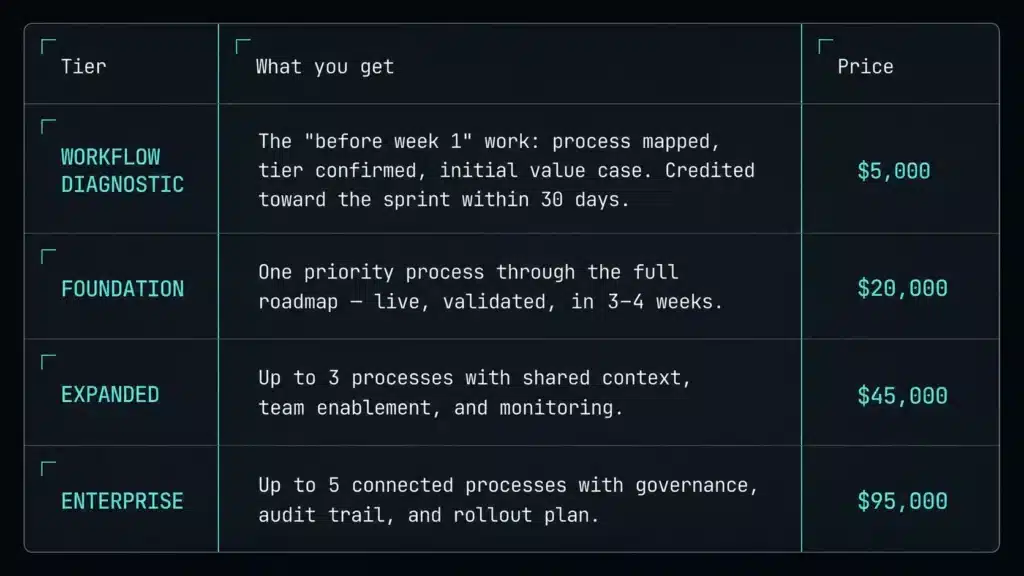
Every tier ships the same four deliverables: a working workflow, a reusable redesign pattern, a grounded value case, and a sequenced roadmap. No strategy phase, no new infrastructure, no custom-quote theater.
FAQ
How long does an AI workflow take to build? One well-chosen process: 3–4 weeks through this roadmap. Longer timelines usually mean too many processes at once or a strategy phase attached.
What if our process spans multiple systems? Most do, that’s what the mapping week is for. The workflow orchestrates the judgment layer inside the platform; deep system integration (ERP write-backs, unattended runs) is custom tooling that belongs on the post-validation roadmap, not in week 3.
Can our team run the workflow after it’s live? That’s the point. The workflow lives in the platform your team already uses, and enablement is part of the handoff. You own it, adjust it, and extend it.
Have your process in mind? You probably do; it’s the one your team named in the first section. Start where the sprint starts: the $5,000 Workflow Diagnostic. Very maps your process end-to-end, confirms the right tier, and shows you the value case before you commit to anything more, credited toward your AI Workflow Sprint within 30 days. Book a Meeting