BLOG
How Much Does UX/UI Design Cost in 2026

Search “how much does UX/UI design cost” and you’ll get a range: $1,500 to $150,000+ with no explanation of why it spans two orders of magnitude.
The range isn’t arbitrary. It’s wide because “UX/UI design” is used to describe four fundamentally different deliverables, each with a different price tag, and a different impact on what your developers can actually ship.
Most pricing guides compare hourly rates. This one compares outcomes: what you’re actually paying for, what the market charges in 2026 (real numbers from Dribbble, Tenet UI UX, Orbix Studio, The Skins Factory, and Atico3, not aspirational rates), the mistakes that quietly double the real cost, and how to decide between a freelancer, an agency, or a sprint.
What you’re actually paying for: the four deliverables
Before you evaluate any quote, know which of these four you’re actually buying, because each one ships a different product.

Here’s the part most quotes hide: the cheapest deliverable is rarely the cheapest outcome. A Figma file that costs $15K but adds 30–50% to your development time is more expensive than design delivered as working code, the cost just moved to a different budget line.
“Your team can’t build what they can’t see. Design makes the vision real.”
— Jeff McGehee, President & Managing Partner at Very
What UX/UI design costs in 2026: the market in one table
Six provider types, six pricing models, compiled June 2026:

Read the two right-hand columns carefully, they’re where quotes stop being comparable. Almost the entire market, from $1.5K freelancers to $150K agencies, delivers files. Production code and locked-scope pricing are what separate a design engagement from a design-and-rebuild engagement.
The five variables that move the same project 3×
The same product gets quoted at triple the price depending on five things:
- More screens (×N). A login flow is 4 screens. A full SaaS product is 40+. Complexity compounds.
- More user types (×3). One user type is straightforward. Admins + managers + end users is 3× the design work.
- No design system (+1 hidden line item). Most freelancers skip it. Most agencies charge extra. Either way, you pay, upfront, or in dev time later.
- Time & materials billing ($/hr). Open-ended billing means open-ended cost. Fixed scope protects you.
- Junior, billed senior (↑↓). Always ask who’s actually doing the work, and what they’ve shipped before.
Use these as a quote-reading checklist: any proposal that doesn’t address all five is leaving you to discover them mid-project.
Five mistakes product teams make when buying UX/UI
These show up repeatedly, from early-stage startups to enterprise teams with mature procurement:
- Not asking what’s actually included. “UX/UI design” means different things to different vendors. A Figma file, a system, and working code are three different products.
- Comparing hourly rates instead of outcomes. A $50/hr freelancer who delivers screens your devs can’t use costs more than a $250/hr software engineer who delivers code.
- Skipping the design system. Teams that skip it pay later in inconsistency, redesign cycles, and three days to update a button across 40 screens.
- Assuming Figma is enough for developers. Devs make hundreds of undocumented decisions, spacing, behavior, breakpoints, state. They compound into a different product than the one you approved.
- Hiring junior when you need senior. The difference isn’t polish, it’s the ability to anticipate implementation problems before they get expensive.
Freelancer, agency, or sprint: how to choose
There’s no universally right answer, the right choice depends on stage, budget, and what you need to walk away with.
Hire a freelancer if: budget is under $15K, scope is small and well-defined, you have a developer who can implement from Figma, and you’re validating an early concept rather than shipping a product. Not a fit if you need a design system, working code, or accountability to a deadline.
Hire an agency if: you need strategy, UX research, and UI under one roof, you have an ongoing relationship in mind, and budget is $50K+ with timeline to match. Not a fit if you need to move fast, want a fixed price, or are early-stage.
Book a design sprint if: you need to move in weeks, want design delivered as working code rather than Figma, need a complete design system from day one, and want budget certainty at $20K–$75K. Not a fit if scope needs to evolve significantly, or brand strategy is needed before design.
How Very’s UX/UI Design Sprint is priced
Three fixed-price tiers. Same four deliverables in each — a complete Figma file, a design system, working React components, and a roadmap to launch. What changes is depth:
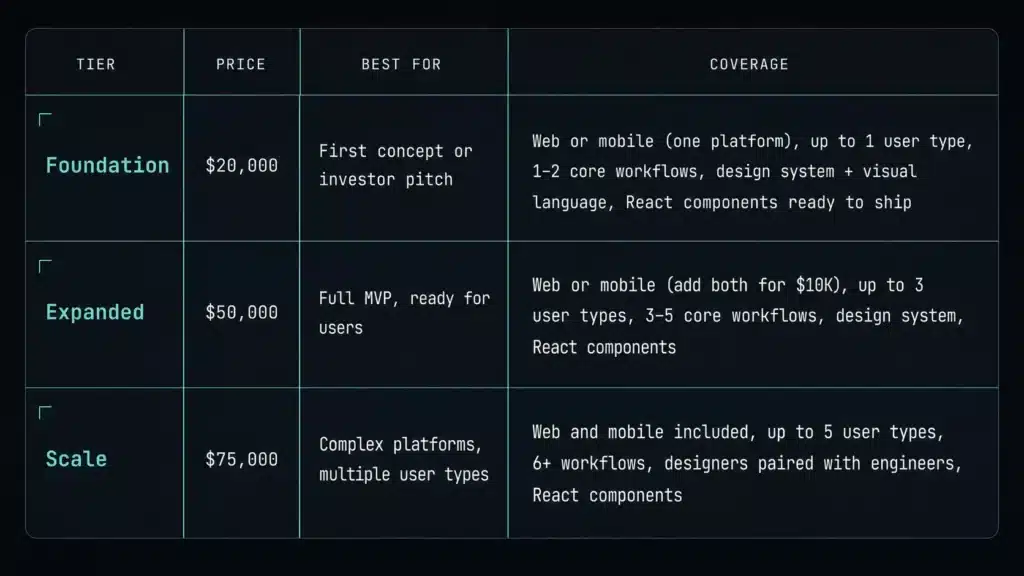
No hourly billing. No surprise invoices. If priorities shift mid-sprint, we reshape the engagement together, we don’t add hours to the bill. And every sprint is led by a senior designer doing the work, not supervising it.
“Our approach is design-led because great products are intentional. Design clarifies vision, makes intent testable, and holds the work accountable to outcomes our clients and their users can feel in the real world.”
— Andrew Frank, Director of Product Design at Very
FAQ
How quickly can a design sprint deliver? As little as two weeks, depending on complexity. You’ll have a clear timeline before work begins.
Can scope change mid-sprint? Yes. If priorities shift, we reshape the engagement together — we adjust scope collaboratively rather than adding hours to the bill.
What does my team need to bring? Ideas for what you want your product to look like and do. We fill in the blanks and do the rest.
Who actually does the design work? Senior designers only — every sprint. Ask who’s designing your product and we’ll tell you exactly who, and what they’ve shipped.
What counts as a “core workflow”? One of the main things a user comes to your product to do, start to finish, device onboarding, sensor monitoring, and analytics reporting are three separate workflows.
Ready to see your product before you build it? Very’s UX/UI Design Sprint gets you from idea to a production-ready front end in one sprint — senior designers only, design delivered as working code, at a fixed price you know before work begins. Book a Meeting