BLOG
How to Turn a Vibe-Coded Prototype Into a Product You Can Launch

Someone on your team, or a contractor, or you personally, sat down with an AI tool and had a working version of your product by the end of the week. The screens look right. You clicked through it. It felt real.
Launch it as it stands and it will break. Quietly at first, with a handful of customers who assume it was their connection. Then all at once, on the day traffic finally arrives, in front of the customers you spent the most to earn.
There is a comfortable idea going around that AI lets less experienced people produce expert-quality work. Wrong. The tools got fast enough that the judgment directing them is now the entire difference between a product that holds and one that falls over in month two.
What is vibe coding good at?
Building software by describing what you want to an AI tool changed three real things, and all three are worth having.
Ideas become visible fast. Instead of reviewing a slide deck, you click through something and react to it. Decisions that used to take a month of alignment take an afternoon.
Exploration got cheap. Three versions of an idea can be built in the time one used to take, so the direction you commit to is the one that won a comparison rather than the one someone argued for best.
More people can participate. Building a first version no longer requires a specialist in one particular technology, which means good ideas get tested sooner and by more of your team.
All of that is genuine progress. The question is what happens after the demo.
Why does a working demo still break?
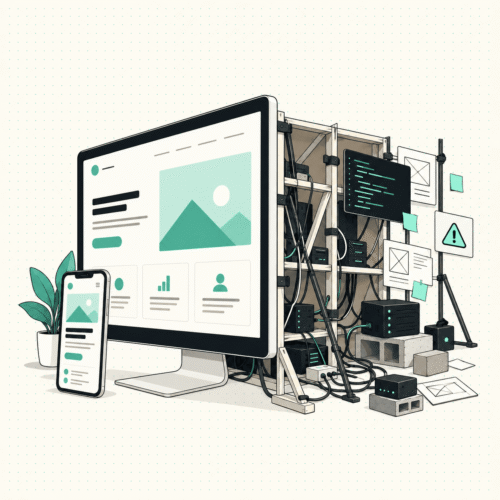
Think of the prototype as a film set. The storefront is convincing from the street. Walk through the door and there is scaffolding behind it.
What you clicked through is the surface: the screens, the buttons, the flow. What sits behind it in a real product is everything that keeps the surface working while you are asleep and ten thousand people are using it at once. Where customer information lives and how it is protected. What happens when two people do the same thing at the same moment. What happens when something fails at 2 a.m. Who is allowed to see what. How the product handles a customer who does something nobody predicted.
An AI tool builds the storefront well. It also does something you won’t see: instead of using a solution the industry settled on years ago, it writes a new one from scratch. Thousands of lines of code nobody has ever used before. It works on day one. After that it is yours to maintain, and every change you ever want to make has to go through it.
Anyone with the tool can build the storefront. Whoever built yours did the right job for that stage. What decides whether your product survives real customers is who builds the rest, and whether they have done it before or are figuring it out on your product.

Your support costs. A flaw that appears one time in twenty is invisible while six people are testing. It happens once, someone refreshes the page, everyone moves on. Put fifty thousand customers through that same path and the same flaw generates thousands of failures a day. Customers will rarely tell you what broke. They will tell you it is slow, it will not load, it stopped working, and they will tell your support team, your app store reviews, and each other.
Your reputation. The window where a new product earns trust is short. Performance problems in the first month cost more than the same problems in year three, because there is no goodwill banked yet.
Your company. Security is a probability question with a permanent consequence. A breach may never happen. If it happens, it can end the business, and prototype-quality software carries meaningfully higher odds of it happening.
Your budget, twice. Launching on a foundation that needs replacing means paying to build the product once, then paying again to rebuild underneath live customers, which is by far the more expensive of the two.
Every one of those outcomes is settled before launch day, by whoever built the foundation. Improvising it means finding out which parts were guesses at the moment guessing costs the most.
What has to be true before you launch?
Four questions, worth asking whoever is building for you.
Who decided the structure? The way a product is organized, secured, and prepared for load should be decided by an experienced person before anything gets built, then executed at speed. A structure that emerged from whatever the tool produced is a structure nobody chose.
What is it built on? Proven, widely used foundations are boring on purpose. They have been attacked, stress-tested, and fixed by thousands of people already. Original solutions to solved problems become yours to maintain alone.
Who is reviewing the work, and what have they shipped? Automated review catches a great deal, and it should be running constantly. The judgment about whether the whole thing will hold up belongs to someone who has watched products fail in the field and knows what that looked like in the months beforehand.
What is real and what is a facade? Ask directly, and ask again each time you are shown something. A screen that works is persuasive in a way that a caveat is not. A good partner will tell you three times without being asked once.
Where Very fits
Very has been designing and building connected hardware, software, and AI systems since 2011, for companies whose products have to ship and keep working.
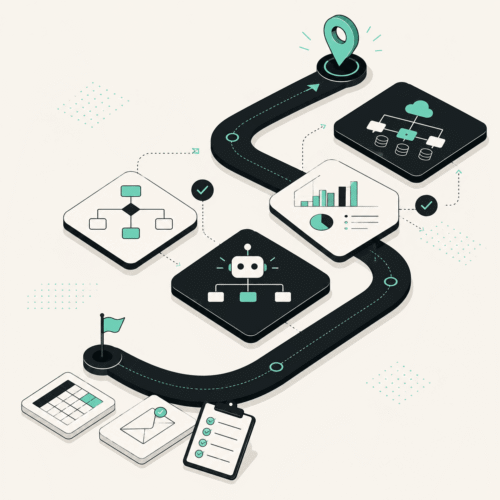
That history is why the AI tooling produces something durable here. Fifteen years of shipping produced a library of approaches we know hold up in the field, and that library is built directly into the AI tools our engineers use, so the work starts from foundations that already have security and scale designed in. An experienced engineer decides the structure first, AI executes inside those decisions, and automated review runs against the work continuously.
The people doing that directing matter more now, not less. AI automates the routine building, which puts the entire value of the person in direction and judgment. It is a Gatling gun rather than a pea shooter, and the only thing that matters is whether whoever holds it knows where to point it.
The tools are extraordinary and getting better every month. The one thing they cannot supply is someone who already knows what your product has to survive.
If you have a prototype that needs to become a product, Book a Meeting and we will tell you what it takes.