BLOG
How to Leverage AI Without Buying New Software

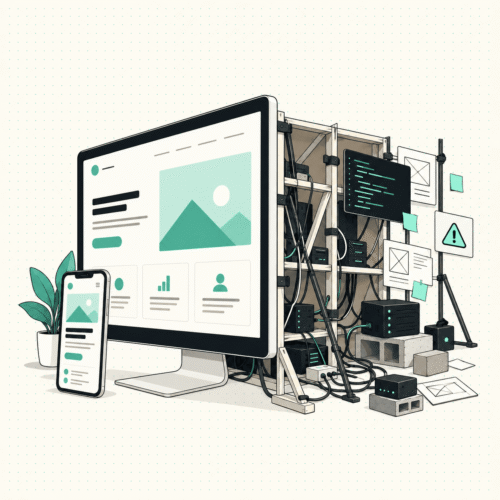
Every company has them: the processes that actually run the business, held together by spreadsheets, email threads, and someone named Karen who is the only person who knows how the exceptions work. Invoice processing. Supplier onboarding. Claims triage. Customer service routing.
You know AI should be able to fix this. You may even already pay for the AI that can in the form of Copilot, ChatGPT, or Claude sitting on your team’s desktops. And yet the process still runs on spreadsheets, because nobody has done the actual work of redesigning it.
And most teams ask the same question: how do we take one manual process and run it on AI? We can tell you how and where our AI Workflow Sprint can help.
Why most AI automation attempts die
Before the method, the failure modes. If you’ve already tried, one of these probably killed it:
- The proof of concept that never went anywhere. A slick demo on sample data, no exception handling, no owner, no path to production. Impressive in the meeting, dead by the next quarter.
- The strategy deck. A consultancy assessed your “AI readiness” for six figures and left a roadmap. The process still runs on email.
- The RPA bot. Robotic process automation scripted the keystrokes of the existing broken process. Now it’s the same process, but brittle, and every form change breaks a bot.
- The dashboard. A tool that shows you the inefficiency in beautiful charts, while your team keeps doing the work manually.
The common thread: none of these redesigned the process. They decorated it. Automation applied to a bad process just produces bad outcomes faster.
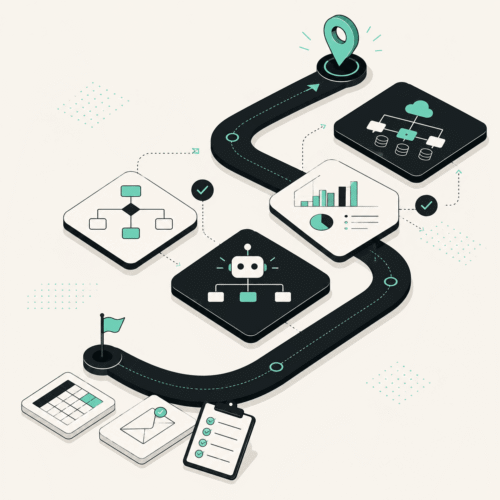
The 5-step method: from manual process to AI workflow
Step 1: Pick one process
Not “transform operations.” One end-to-end operation: order-to-cash, invoice-to-payment, claim-to-resolution, hire-to-onboarded. Pick the one causing the most visible pain, the backlog everyone complains about, the exception queue that eats a full-time job.
Starting with one isn’t thinking small. It’s how you get a measurable win that funds and de-risks everything after it.
Step 2: Map it end-to-end
Document what actually happens, not what the SOP says happens: every handoff, every “then I email Karen,” every judgment call. The exceptions are the whole game, a workflow that handles the happy path and chokes on exceptions creates more manual work, not less.
Step 3: Redesign it with AI
This is the step everyone skips, and the reason everything in the failure list above fails. Go through the mapped process and make a call at each step:
- AI takes it: extraction, classification, drafting, cross-referencing, summarizing, routing. High-volume, pattern-heavy, verifiable.
- A human keeps it: approvals with real consequences, judgment calls on ambiguous cases, anything with regulatory or relationship weight.
- It disappears: a surprising number of steps exist only because the process grew by accretion. Redesign deletes them.
The restraint is the expertise. AI everywhere is how you automate your exceptions into disasters; AI where it earns its place is how the workflow survives contact with reality.
Step 4: Build it inside the AI platform you already use
Here’s the step that saves you a procurement cycle and a security review: the workflow should live inside Copilot, Claude, or ChatGPT, on your existing tenant, under your existing security and licensing. No new vendor, no new infrastructure, no new place for your data to go (and no, your data should never train anyone else’s models).
This is also how those AI licenses you’re already paying for finally start earning their line item.
Step 5: Validate on real data
Run the workflow on actual historical cases and measure it: accuracy rate, exception rate, hours returned to the team. Not projected ROI, measured results. Those numbers do double duty: they tell you whether to trust the workflow, and they build the value case that gets the next process funded.
Then roadmap what’s next, because the second process is faster than the first, the patterns are reusable.

Every engagement starts with a $5,000 Workflow Diagnostic: we map your candidate process, confirm the right tier, and build the initial value case.
It’s credited toward the sprint if you proceed within 30 days, so the real cost of finding out is a diagnostic, not a transformation budget.
Every tier ships the same four things: a working workflow (live, not slideware), a reusable redesign pattern, a grounded value case with real numbers, and a sequenced roadmap.
FAQ
Which processes are the best first candidates? The ones with high volume, clear rules, and painful exceptions: invoice exception handling, supplier onboarding, claims adjudication, customer service triage, reconciliation. If a process is eating a disproportionate share of a team’s week, it’s a candidate.
We already pay for Copilot / ChatGPT / Claude. Isn’t this built in? The platform is the engine; the workflow is the vehicle. Licenses give your team a chat window, they don’t map your process, decide where AI belongs in it, or validate it against your exception queue. That’s the redesign work, and it’s why adoption stalls without it.
How is this different from RPA? RPA scripts keystrokes on top of the process as-is, heavy, brittle, and expensive to maintain. This method redesigns the process itself and embeds AI natively, so it adapts as fast as a prompt instead of a bot-maintenance backlog.
What about fully autonomous runs — ERP write-backs, unattended execution? That layer requires custom tooling beyond the platform, and anyone who promises it inside a chat-platform deployment is overselling. It’s scoped honestly on the roadmap when the workflow has earned that trust.
Does our data leave our environment? No. The workflow runs on your tenant under your existing security, and your data is never used to train anyone else’s models.
Find your first process The $5,000 Workflow Diagnostic tells you which process to start with, what it will cost, and what the numbers say, credited toward your sprint within 30 days. Book a Meeting