BLOG
How do you take a hardware prototype to production?

Connected products stall between prototype and production because the two stages answer different questions. A prototype proves the product works. Production asks whether the materials exist at the quantity you need, whether the lead times fit your launch, and whether the unit cost still holds at volume. Those three answers usually arrive late.
The three things that change at volume
At Very Technology, we have watched this sequence play out across fifteen years of hardware programs. Jessica Begley, Vice Chair of our board, describes what companies find when they move from a working prototype to a real production run:
“The materials are not available in the bulk size that you actually need. The time and the process to create it is much longer than they actually ever anticipated. And the cost of this unit is going to be so much substantially more than they ever had figured into their calculation.”
Each one arrives at the worst possible moment, after the design is settled, the launch date is public, and the budget is approved.
Why the production questions arrive later
The teams who own a prototype are solving exactly the right problem for the stage they are in. As Jessica puts it, “the individuals who are owning the prototype, they just want a prototype that works. It meets the requirements, they’re working in small batches, so they’re thinking more about just the prototype.”
That focus is correct. A prototype that does not work teaches you nothing. The gap opens because production constraints live in a different set of questions, and nobody is being asked those questions yet.
Design backward from the production number
The fix is to put the volume conversation at the front of the engagement rather than the end. At Very, that is what we spend the first weeks of a hardware program doing. Jessica describes it this way:
“Typically what we do is we spend those first couple of weeks truly understanding the long-term game and the impact that you’re trying to play into. What is the end result? Are you looking for a certain number, but is that number just this year? What if you only need 1,000 units this year, but it’s 10,000 next year? That changes the course of the conversation.”
One thousand units and ten thousand units are different products. They can call for different materials, different assembly processes, different tooling, and a different supplier conversation. Knowing which one you are building changes what you design.
The same applies to the requirements that shape component choice: what the materials need to withstand, what the life cycle looks like, what battery life the product has to deliver. Each of these narrows the field of parts that will work, and each is far cheaper to answer before the design is locked.

Build a prototype that is already close to production-ready
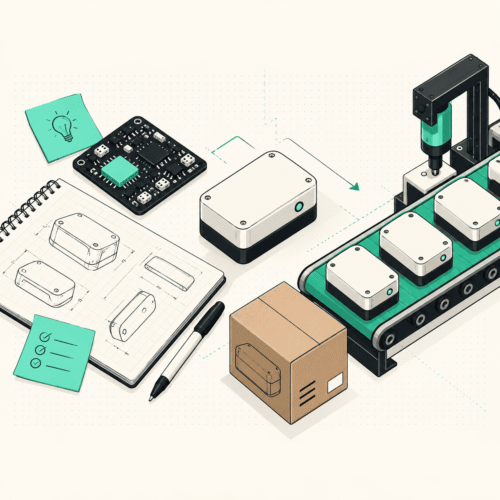
Once the production picture is clear, you can work backward into the prototype. That is how we build at Very. In Jessica’s words, the prototype comes out “pretty much pretty close to production-ready and certification-ready as possible.”
Certification is the part teams tend to leave for later. Treating it as a design input rather than a final gate keeps a product from reaching the end of its build and discovering it has to change to pass.
Handoffs still happen. Multiple teams touch a product on its way to market, and plans change along the way. What changes is whether those moments are anticipated. Jessica frames the goal simply: “We really try to be the partner who thinks that through with you from end to end, so there are no surprises or gotchas halfway through the project.”
Common questions
How early should the production volume be decided?
Before the design is locked. You do not need a precise forecast, but you do need to know the order of magnitude and how it changes over the first two years, because that is what determines material choices, tooling decisions, and which suppliers can serve you.
What makes unit cost come in higher than planned?
Usually a combination of three things: components priced at prototype quantities rather than production quantities, assembly steps that are workable by hand and expensive at scale, and tooling costs that were modeled generously. All three are visible early if you run the numbers at the production volume rather than the prototype volume.
Can a prototype be certification-ready?
It can be close. Designing against the certification requirements from the start means the testing phase confirms what you built rather than sending you back to change it. That is the difference between weeks of scheduled testing and a redesign.
If you are heading toward a production run and want the volume, cost, and certification questions answered while the design is still open, we can help you work through them. Book a Meeting