BLOG
How to Choose an AI Consulting Firm

You got the mandate “make sure we are using AI”. Maybe it came from the board. Maybe from a CEO who watched a competitor announce an AI initiative. Maybe from your own team, drowning in a process held together by spreadsheets, email, and manual handoffs.
So you googled. And you found a market that looks like this: global consultancies selling transformation programs, boutiques selling custom builds, platform vendors selling licenses, and no obvious way to tell which one will leave you, six months from now, with a workflow that actually runs. With so many options out there, how do you know who to choose?
This guide maps the three types of AI partners, the questions that expose which one you’re talking to, and the signals that predict whether your AI project ships.
Three Types of AI Partners
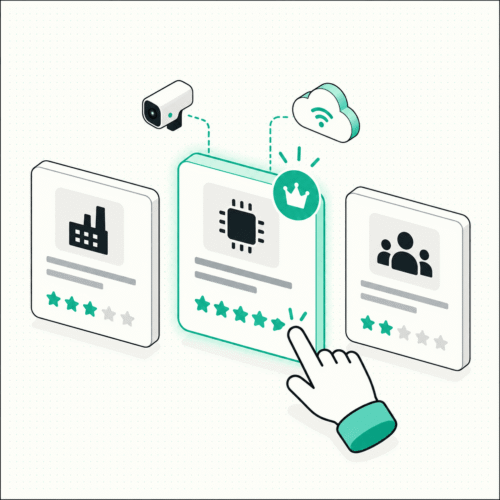
Almost every firm pitching AI services falls into one of three groups. None of them is bad. But each is built for a different buyer, and choosing the wrong type is the most common way AI budgets evaporate.
Type 1: The Strategy-First Consultancy
The Big-4 and global system integrators sell AI transformation as a program: assessment, roadmap, governance framework, multi-quarter rollout. It’s the safe choice for a board-mandated, enterprise-wide initiative, and the wrong one if what you need is a working workflow this quarter. Engagements typically start in the hundreds of thousands dollars, timelines run in quarters, and implementation is often a separate contract (or a separate firm).
Choose this type if you’re a large enterprise buying boardroom air cover and a multi-year operating model.
Walk away if you hear “phase one is a strategy assessment” and what you wanted was a process fixed.
Type 2: The Custom-Build Boutique
Mid-market AI consultancies bridge strategy and implementation, usually on custom scope, custom quotes, and custom timelines. The good ones do real work. The structural problem: custom everything means you can’t compare prices, can’t predict timelines, and often can’t see the deliverable clearly until you’re deep in the engagement.
Choose this type if your problem genuinely requires bespoke infrastructure from day one.
Walk away if the proposal can’t name a fixed price, a fixed timeline, and a concrete deliverable.
Type 3: The Platform
There are a multitude of remarkable AI platforms that provide a specific service or workflow. Around each sits an ecosystem of certified partners who deploy the platform: tenant setup, security configuration, license rollout. What most of them don’t do is the harder work underneath: redesigning the operational process itself, deciding where AI belongs in it and where human judgment must stay.
Choose this type if you need the platform installed and governed.
Walk away if you’ve already bought the licenses and adoption is stalling, installation was never your problem. Workflow design was.

The one question that sorts them all
If you ask only one thing in every sales conversation, ask this:
“What is running in production, on our systems, validated on our data, at the end of this engagement?”
Strategy firms will answer with a roadmap. Platform installers will answer with a deployment. A true implementation partner answers with a specific, working workflow, live inside the AI platform your team already uses, measured for accuracy and exception rates on your real data.
That distinction: slideware vs. software, predicts AI project success better than any credential on the pitch deck.
Seven questions to ask before you sign
- “Will the solution run on our existing tenant, under our existing security and licensing?” If the answer involves standing up new infrastructure for a first project, complexity is being sold to you, not solved for you.
- “What’s the fixed price, and what exactly does it buy?” Published, tiered pricing is rare in this market, and its absence usually means the scope is designed to grow.
- “How do you decide where AI does not belong?” The best partners can name the steps where human judgment must stay in the loop. A partner with no answer will automate your exceptions into disasters.
- “Who actually does the work?” Senior engineers who have deployed AI in production for years, or a bench that’s been vibe-coding since 2024? Ask how long the team members have been shipping.
- “How fast does the first workflow go live?” Weeks is a real answer. Quarters is a strategy program wearing implementation clothes.
- “What happens to our data?” The correct answer is unambiguous: it stays on your tenant and is never used to train anyone else’s models.
Red flags, in order of expense
- The engagement starts with a strategy phase and implementation is “scoped later.”
- The demo is impressive but generic, it hasn’t touched your data, your exceptions, or your edge cases.
- Every process is a candidate for AI. Restraint is the expertise. A partner who never says “that step should stay human” hasn’t done this in production.
- The pilot has no path to production, no validation plan, no exception handling, no owner after handoff.
- Pricing is a percentage of vague future savings rather than a committed scope with a committed deliverable.
What choosing right looks like in practice
We built Very’s AI Workflow Sprint as the direct answer to this buying problem, a fixed-price, fixed-scope engagement that takes one of the operational processes your business runs on and redesigns it with AI embedded where it earns its place:
- Starts with a $5,000 Workflow Diagnostic that confirms the right scope, credited toward the sprint if you proceed within 30 days. You risk a diagnostic, not a transformation budget.
- Ships live inside Claude, ChatGPT, or Copilot, on your tenant, under your existing security and licensing, with no new infrastructure to stand up.
- Validated on real data, with accuracy and exception rates measured, plus a grounded value case and a sequenced roadmap of what to redesign next.
- Three tiers, published prices: Foundation ($20,000, one priority process, live in 3–4 weeks), Expanded ($45,000, up to three processes with team enablement), and Enterprise ($95,000, up to five connected processes with governance, audit trail, and change management).
- Built by senior engineers who have been deploying AI in production systems for a decade, not since the market got exciting.
In other words: every answer to the seven questions above, in writing, before you spend a dollar past the diagnostic.
FAQ
What counts as one “process”? One end-to-end operation, order-to-cash, invoice-to-payment, claim-to-resolution, hire-to-onboarded. The diagnostic maps yours and confirms scope.
We already pay for Copilot/ChatGPT/Claude licenses. Is this redundant? The opposite, it’s how those licenses start paying for themselves. The workflow is built inside the platform you already own.
What about fully autonomous workflows — ERP write-backs, unattended runs? That requires custom tooling beyond the platform layer. It’s scoped honestly on the roadmap, not promised in the sprint.
How is this different from RPA? RPA automates keystrokes on top of a process as-is; it’s heavy, brittle, and slow to change. The sprint redesigns the process itself, with AI embedded where it earns its place, and adapts as fast as a prompt, not a bot-maintenance backlog.
Start with the diagnostic, not a leap of faith. The $5,000 Workflow Diagnostic tells you which process to start with, what tier fits, and what the value case looks like, credited toward your sprint if you proceed within 30 days. Book a Meeting